INTEGRATED MODEL

One scientific framework connecting brain evaluation, rehabilitation and human performance.

NeuroSports USA combines functional neuropsychological evaluation, brain-network interpretation and the MNSI intervention model to guide clinical recovery and cognitive performance.

Public Process Architecture

How NeuroSports USA Works

A progressive public view of our integrated framework, designed to explain purpose, sequence and functional application without publishing proprietary clinical methodology.

Functional Evaluation establishes an evidence-informed baseline before any intervention pathway begins. NeuroSports USA integrates structured neuropsychological testing, clinical observation, developmental and medical context, and functional information from daily-life, academic or performance environments. This process helps identify strengths, vulnerabilities and priority targets that can guide individualized recommendations for rehabilitation, academic support or NeuroPerformance planning. Public reporting remains focused on functional interpretation and practical guidance. Internal scoring structures, proprietary weighting methods and decision criteria are managed by licensed professionals and are not published in public-facing materials.

Explore Evaluation
Functional Brain Networks, referenced through RSFN, provide a conceptual framework for understanding how cognitive systems interact with behavior and real-world demands. NeuroSports USA uses this perspective to connect assessment findings with attention, regulation, executive control and adaptive performance patterns. Public content explains this framework at a clinical-educational level so families, patients and athletes can understand why targeted planning matters. Internal inference logic, network-priority rules and proprietary interpretation criteria remain protected as part of supervised professional practice. RSFN supports clinical reasoning and hypothesis development; it is not presented as an automated diagnostic system or a guarantee of outcomes.

Explore Our Science

MNSI, Multimodal NeuroSequential Integration, organizes intervention through a progressive structure that moves from regulation and targeted activation toward cognitive work, integration and transfer. The public architecture communicates the sequence so visitors can understand the logic of preparation, training and application without exposing proprietary clinical parameters. Programs are individualized according to evaluation findings, professional judgment and functional goals in care or performance settings. Specific technical configurations, stimulation settings, task protocols and internal adaptation criteria are intentionally excluded from public materials. Implementation always occurs under trained supervision with continuous monitoring and periodic adjustment based on functional response.

Explore the Model

Clinical Neuroscience services are designed to support individuals with cognitive, behavioral, developmental, neurological or psychiatric needs across the lifespan. NeuroSports USA may integrate neuropsychological evaluation, functional diagnosis, cognitive rehabilitation and support strategies for academic or daily-life functioning. The objective is to guide individualized care planning and monitor practical change over time with evidence-informed criteria. Public content communicates scope and structure while avoiding publication of internal clinical algorithms, protocol specifications or proprietary decision pathways. Recommendations are always adapted to each profile, contextual demands and multidisciplinary clinical oversight rather than standardized one-size-fits-all sequences.

Explore Clinical Services

NeuroPerformance applies functional neuroscience to competitive and high-demand environments where cognitive efficiency influences execution quality. Programs can address attention control, decision-making speed, reaction timing, cognitive endurance and transfer to sport-specific performance contexts. NeuroSports USA structures this work from individualized profiling and functional priorities, not generic drills. Public communication remains conceptual and evidence-informed, without exposing proprietary training architecture, internal adaptation algorithms or detailed protocol criteria. Progress is monitored through functional indicators and contextual observation under professional supervision, recognizing that outcomes depend on participant characteristics, training adherence, competitive context and coordinated multidisciplinary support.

Explore NeuroPerformance

Functional Outcomes are tracked using baseline information, session-level indicators, contextual observation and periodic reassessment checkpoints. NeuroSports USA uses monitoring to guide adjustments, reinforce useful gains and evaluate transfer into clinical, academic, daily-life or sport demands. Public materials clarify that this process supports evidence-informed decision-making rather than guaranteed results. Progress can vary according to participant profile, clinical condition, engagement quality, environmental factors and program adherence over time. Internal scoring formulas, weighting models and proprietary decision thresholds remain protected and are not disclosed in public-facing content. Outcome interpretation is conducted by qualified professionals within individualized care frameworks.

How We Track Progress

RSFN

Functional Brain Networks (RSFN)

RSFN provides a functional framework for interpreting how brain systems, cognitive processes and behavioral outcomes interact.

RSFN supports:

  • functional network analysis
  • clinical interpretation
  • hypothesis generation
  • intervention priorities
  • outcome prediction

RSFN-based interpretation informs decision-making and planning but does not imply guaranteed diagnostic or therapeutic outcomes.

MNSI

MNSI - Multimodal NeuroSequential Integration

MNSI organizes intervention into a structured sequence that prepares brain state, activates targeted networks, trains cognition, consolidates learning and transfers gains to real-life performance.

Phase 01

Regulation

Prepare attention, arousal and emotional state.

Phase 02

Neuromodulation

Support targeted neural-network preparation.

Phase 03

Digital Cognitive Training

Activate attention, memory, processing speed and executive functions.

Phase 04

Analog Integration

Transform digital performance into symbolic and functional tasks.

Phase 05

Sensorimotor Consolidation

Reinforce cognitive change through movement and response control.

Phase 06

Functional Transfer

Apply trained abilities to clinical, academic, daily-life or sport contexts.

TWO APPLICATIONS

One Model. Two Applications.

A single scientific framework supports two implementation pathways with shared principles.

Clinical Neuroscience

  • Pediatric Neuropsychology
  • Adult Neuropsychology
  • Neurological Conditions
  • Psychiatric Conditions
  • Cognitive Rehabilitation
  • Academic and Functional Support

NeuroPerformance

  • Soccer
  • Basketball
  • Baseball
  • Tennis
  • Individual Athletes
  • Decision-Making
  • Reaction Time
  • Attention Under Pressure
  • Cognitive Endurance

Clinical Neuroscience and NeuroPerformance are applications of the same integrated scientific model, not separate businesses.

SESSION STRUCTURE

A Structured 90-Minute Intervention Journey

Each intervention session follows a predefined distribution of time across the MNSI sequence.

10 min

Regulation

15 min

Neuromodulation

25 min

Digital Cognitive Training

20 min

Analog Integration

15 min

Sensorimotor Consolidation

5 min

Functional Transfer

Session duration and components are individualized according to evaluation findings, clinical judgment and functional goals.

OUTCOME MONITORING

Tracking Functional Change

Monitoring links session-level indicators with broader functional progression.

baseline profile
session indicators
cognitive progression
functional transfer
clinical or sport-specific outcomes
periodic reassessment

Outcome monitoring supports clinical reasoning and performance planning but does not represent guaranteed outcomes.

Locations

Our Current Centers

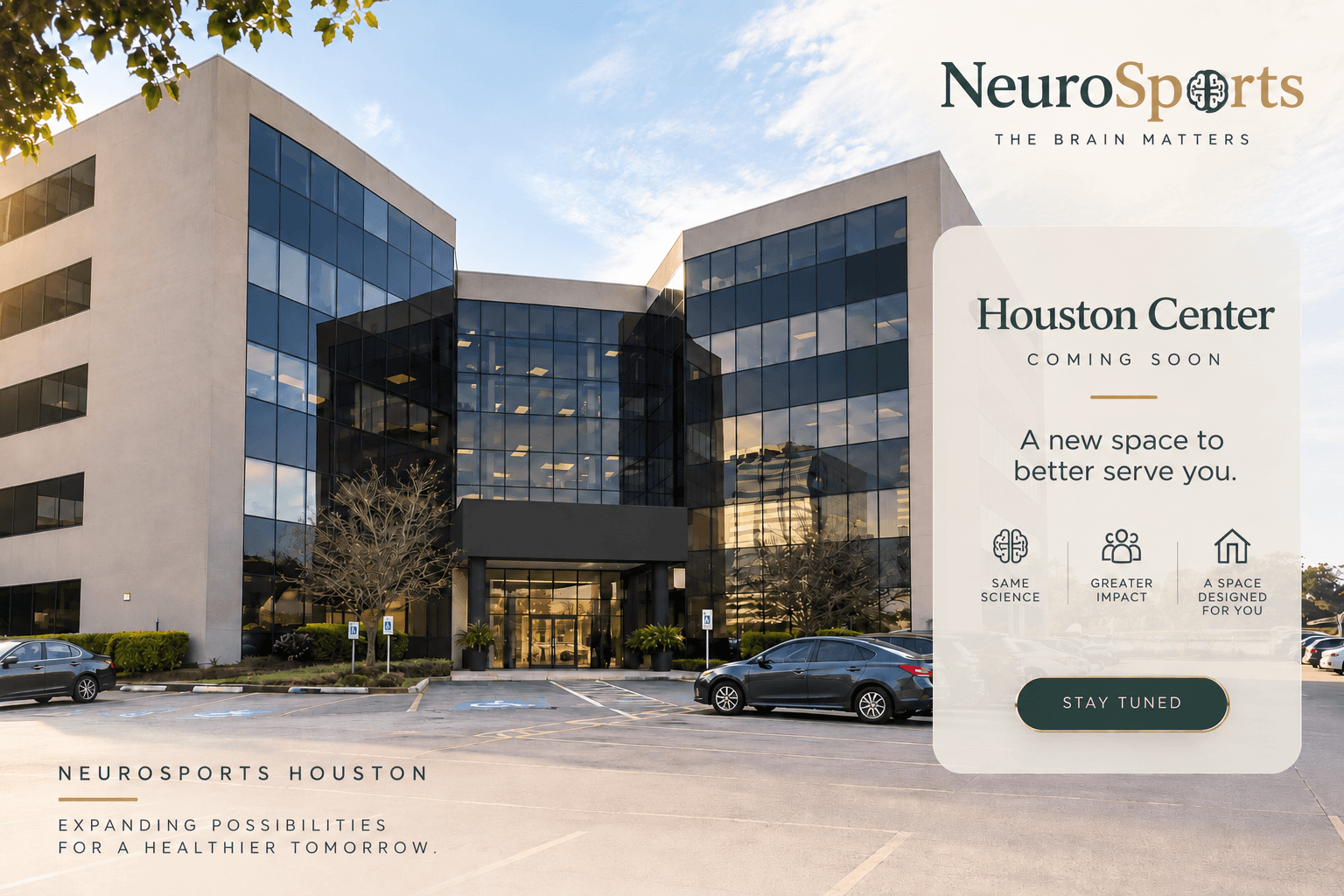
NeuroSports USA team outside the Houston center at 11777 Katy Freeway.
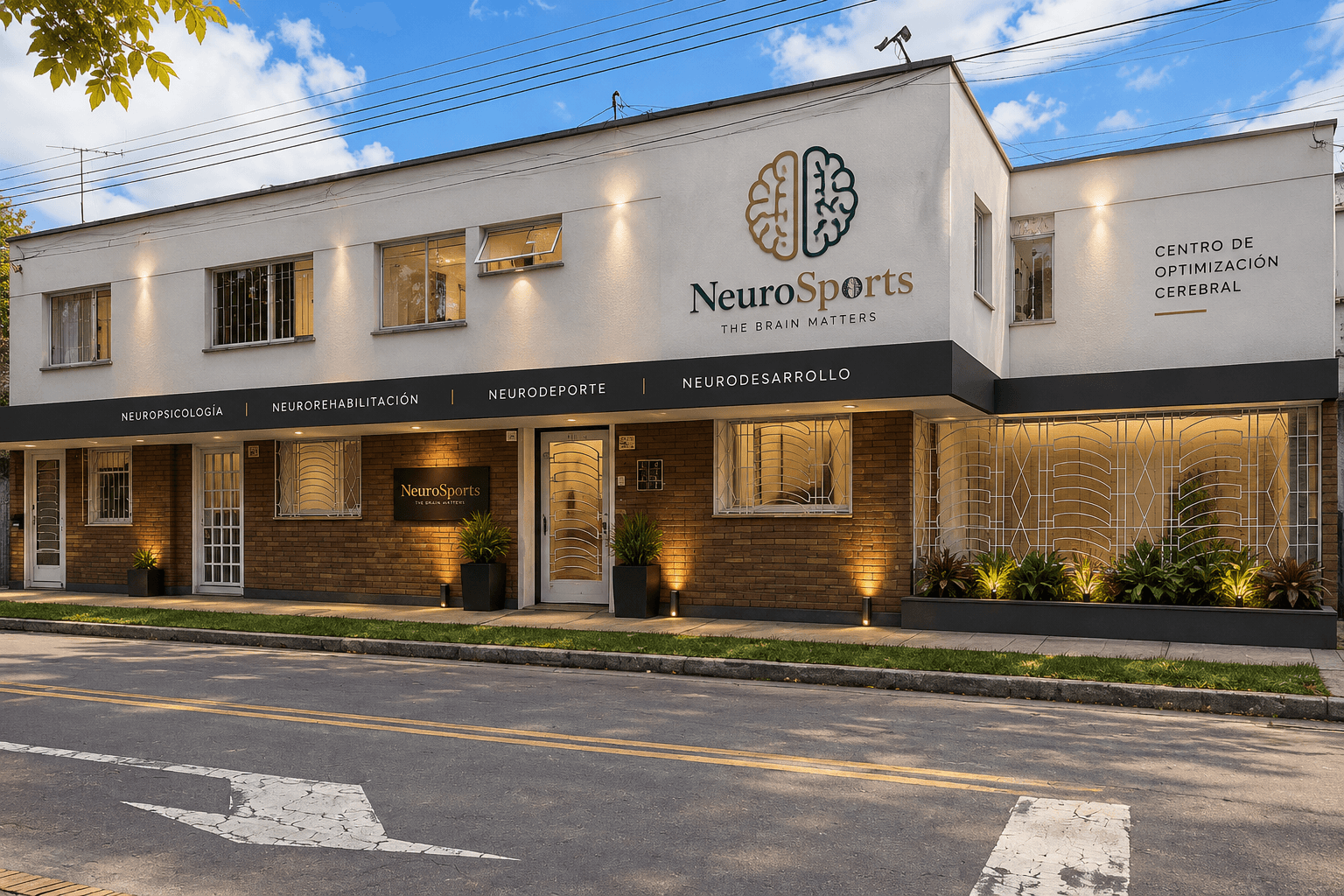
NeuroSports USA clinical and NeuroPerformance team at the Houston center.

NeuroSports USA

Houston Center

Houston, United States

11777 Katy Freeway, Suite 410S

Get Directions
NeuroSports USA team outside the Houston center at 11777 Katy Freeway.
NeuroSports USA clinical and NeuroPerformance team at the Houston center.

NeuroSports USA

Houston Center

Houston, United States

11777 Katy Freeway, Suite 410S

Houston, Texas 77079

United States

Initial Evaluation appointments

Public Appointment Hours

Monday-Friday

8:00 AM-12:00 PM

2:00 PM-4:00 PM

Saturday

9:00 AM-12:30 PM

Central Time — Houston

Center Gallery

Photography Coming Soon

Bogotá Center

Bogotá, Colombia

CENPA IPS

Bogotá Center

Bogotá, Colombia

Carrera 23 No. 87-10

Get Directions

Bucaramanga Center

Bucaramanga, Colombia

CENPA IPS

Bucaramanga Center

Bucaramanga, Colombia

Carrera 35A No. 48-134, Piso 2

Get Directions

NeuroSports USA and CENPA IPS are separate organizations that share scientific principles and selected intervention frameworks.

INSTITUTIONAL METHODS

RSFN, MNSI and NeuroPerformance as differentiated institutional methods.

The integrated model aligns interpretation, intervention sequencing and transfer-oriented application within one public scientific architecture.

RSFN

Functional Brain Networks (RSFN)

RSFN provides a functional framework for interpreting how brain systems, cognitive processes and behavioral outcomes interact.

Learn About Research
MNSI

MNSI - Multimodal NeuroSequential Integration

MNSI organizes intervention into a structured sequence that prepares brain state, activates targeted networks, trains cognition, consolidates learning and transfers gains to real-life performance.

Explore Six-Phase Model
NEUROPERFORMANCE

NeuroPerformance

Functional neuroscience applied to attention, decision-making, reaction time, cognitive endurance and sport transfer.

Explore NeuroPerformance

ECOSYSTEM ARCHITECTURE

NeuroSports USA as a central institutional platform.

This view organizes institutional methods and applications without exposing independent clinical or scientific platforms.

Institutional Platform

NeuroSports USA

Public platform to communicate institutional scientific architecture, models and applications under professional governance.

Architecture note

Public platform presentation only. Clinical and scientific internal systems remain independent and are not exposed from this section.

Institutional method

RSFN

Scientific methodology for functional interpretation.

Relation: Institutional scientific foundation

Clinical intervention model

MNSI

Clinical sequential intervention model.

Relation: Institutional supervised implementation

Applied performance pathway

NeuroPerformance

Sport application focused on functional transfer.

Relation: Application of the institutional framework

Future tool - pending validation

NeuroScanner

Future specialized tool in institutional development.

Relation: Future ecosystem component

FINAL CTA

Begin With a Functional Evaluation

Every clinical and performance pathway begins by understanding the individual brain profile, functional priorities and real-world goals.

Schedule an Evaluation